


"Natural" is not a regulated term in Australian cosmetics labelling. Neither is "holistic", "clean" or "toxin-free". Any brand can print any of them on any tube, and they do.
That is not a reason to write off the category. It is a reason to have your own criteria. Here are the four I use, which are the same ones I used when I formulated ours.
One: it has to do something
The criterion most natural toothpaste fails, and the one that matters most.
Read the panel on a lot of them and you find an abrasive, a humectant, a thickener, a foaming agent, a flavour, and some botanical extracts in quantities too small to matter. It cleans mechanically. That is worth something. But there is no named key ingredient beyond the cleaning base.
Removing fluoride is not an improvement by itself. It is a subtraction. Check what has been put in its place.
In ours that means nano-hydroxyapatite, a mineral that occurs naturally in teeth and bones, which gives a smooth, polished, clean feel. We use 3% nano-hydroxyapatite. Background in how nano-hydroxyapatite works.
The test: find the key ingredient. Find its percentage. No named ingredient means it is a cleaning paste. An ingredient with no stated percentage means you cannot compare it.
Two: it has to leave out what has no reason to be there
Subtraction with a reason attached, rather than subtraction as marketing.
Sodium lauryl sulfate is the clearest case. A detergent whose only function is foam, and foam does not clean. It irritates soft tissue and is linked to recurrent mouth ulcers. Removing it costs you nothing but lather you were trained to expect.
Artificial colours do nothing whatsoever in something that spends two minutes in your mouth.
Titanium dioxide is a pigment, in there to make the paste look brighter. No function, unresolved questions about ingestion, easy to leave out.
Excessive abrasives are the quiet one. Highly abrasive whitening formulas can wear enamel over time. A gentle everyday paste does not need them.
What this criterion is not: an argument that synthetic means suspect. Sodium bicarbonate is baking soda. Cellulose gum is plant fibre. Xylitol is manufactured and sweetens without sugar. Function is the point, not the name. Full breakdown, including the ingredients that get more alarm than they deserve, in toothpaste ingredients to avoid.
Three: it has to consider the ecosystem, not just the teeth
The criterion that has changed most in the last decade, and the one most products have not caught up with.
Hundreds of bacterial species live in your mouth, and most are harmless. Your mouth is not meant to be sterile.
That changes how I think about a toothpaste. I would rather clean well and leave out harsh extras than try to wipe out everything in the mouth.
A product designed with this in mind cleans mechanically, avoids indiscriminate antibacterial agents, and leaves out the irritants. Some add prebiotic ingredients such as chicory root inulin. I would say plainly that the evidence for those ingredients is early rather than established, and I have set out where it stands in the oral microbiome.
Four: the claims have to survive being checked
Less about chemistry, more about whether the brand is worth trusting.
- Does it name a percentage, or only an ingredient?
- Does it say nano or non-nano? Both are legitimate and they work differently. A brand that will not specify is either not being careful or not wanting to be.
- Does it separate what is proven from what is promising? A brand claiming its prebiotic, or its toothpaste, treats a dental condition has told you how much weight to put on everything else it says.
- Is "vegan" or "cruelty-free" doing the work that "effective" should be doing? Both are legitimate reasons to choose a product. Neither says anything about whether it does its job.
What holistic should actually mean
A holistic toothpaste does three things at once, and the "at once" is the point. It names its key ingredient and states the percentage. It leaves out what has no reason to be there. It cleans without trying to sterilise your mouth.
Most products on the natural shelf manage the second. That is the easy one, mostly a matter of what you decline to add. Far fewer manage the first. The third is where the category is still developing, and honesty about the state of that evidence is itself a mark of a brand worth trusting.
Thirty seconds in the aisle
- Turn it over and find the key ingredient. Is there one? What percentage?
- Scan for SLS, artificial colours, titanium dioxide.
- Check whether it claims anything it could not possibly substantiate.
- Then, and only then, look at the front of the pack.
The front is written by a marketing team. The back is written for a regulator.
Frequently asked questions
What makes a toothpaste natural or holistic?
Neither term is regulated in Australia, so the label alone means little. A working definition: a named key ingredient at a stated percentage, no ingredients with no function such as SLS, artificial colours and titanium dioxide, and no broad antibacterial agents.
Is natural toothpaste as effective as regular toothpaste?
It depends on what is in it. A natural toothpaste with a named key ingredient at a stated percentage gives you something to compare. One without cleans mechanically, and that is all it does.
What should I look for in a natural toothpaste?
A disclosed active and its percentage, no sodium lauryl sulfate, low abrasivity, xylitol rather than a purely cosmetic sweetener, and claims that separate what is proven from what is promising.
Is "toxin-free" toothpaste a real thing?
"Toxin-free" is marketing rather than a regulatory category, and the ingredients it usually refers to are not toxins at the concentrations used. The useful question is not whether an ingredient sounds alarming but whether it has a function worth its presence.
Does natural toothpaste have to be fluoride-free?
No. They are separate questions and some natural-positioned products contain fluoride. What matters is that the product contains a meaningful active ingredient, whether that is fluoride or hydroxyapatite.
Flossy & Pure toothpaste is a cosmetic product and is not intended to diagnose, treat, cure or prevent any disease. For advice about your own teeth, speak with your dentist or Oral Health Therapist.
References
Enax J, Epple M. Synthetic hydroxyapatite as a biomimetic oral care agent. Oral Health & Preventive Dentistry. 2018;16(1):7-19.
Marsh PD. In sickness and in health, what does the oral microbiome mean to us? British Dental Journal. 2018;224(5):301-304.
Herlofson BB, Barkvoll P. Sodium lauryl sulfate and recurrent aphthous ulcers. Acta Odontologica Scandinavica. 1994;52(5):257-259.
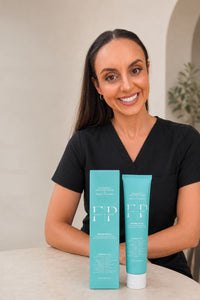
Oral Health Therapist (Bachelor of Oral Health Therapy, University of Newcastle, 2017), 9 years of clinical experience. Founder of Flossy & Pure.
Related reading
- The best hydroxyapatite toothpaste in Australia
- The oral microbiome
- Where to buy hydroxyapatite toothpaste in Australia
Not sure which formula suits you? Take the Enamel Check, a free 60-second quiz from an Oral Health Therapist.
We use 3% nano-hydroxyapatite. Our toothpaste is SLS-free and fluoride-free. We publish our percentage, which most of this category will not.