


If you've ever been told your enamel is "thinning" or that you have early signs of erosion, you've probably heard the word remineralization thrown around. It's one of the most important and most misunderstood processes in oral health. As an Oral Health Therapist, it's also one of the questions I get asked most often: does nano-hydroxyapatite actually rebuild enamel, or is that just marketing?
Here's what's actually happening at the mineral level, and why it matters for how you choose a toothpaste.
What enamel is actually made of
Tooth enamel is roughly 96% mineral, and that mineral is a naturally occurring crystal called hydroxyapatite. It's the hardest substance in the human body, harder than bone but it's not indestructible. Acid from food, drinks, and bacteria strips minerals out of that crystal lattice every time your mouth's pH drops below about 5.5. This happens dozens of times a day for most people. Saliva and minerals in your diet usually replace what's lost. When they can't keep up, you get demineralization: the early, reversible stage of enamel erosion and the precursor to cavities.
Why "nano" matters
Hydroxyapatite itself isn't new, it's been studied in dentistry for decades. What's changed is our ability to manufacture it at a nano scale. When hydroxyapatite particles are small enough (in the same size range as the crystals naturally found in your enamel), they can integrate directly into the microscopic gaps and lesions left by acid erosion, rather than just sitting on the surface.
This is the detail most toothpaste brands leave off their packaging: particle size and concentration. A product can list "hydroxyapatite" as an ingredient without disclosing either, and both determine whether it can actually get into the enamel structure or whether it's just a coating that rinses away.
How the remineralization process works
- Acid exposure demineralizes enamel, opening up microscopic porosities in the crystal structure.
- Nano-sized hydroxyapatite particles are small enough to enter these porosities, rather than remaining a surface layer.
- The particles bond with the remaining enamel structure, effectively patching the weakened lattice with material that is structurally identical to what was lost — because it's the same compound.
- Repeated exposure (i.e. brushing twice daily) reinforces this over time, helping enamel resist future acid attacks.
Why this matters more than fluoride for some people
Fluoride works differently: it converts enamel's hydroxyapatite into fluorapatite, which is more acid-resistant, but it doesn't replace lost mineral volume the same way. Nano-hydroxyapatite is biomimetic, it's the same substance your enamel is already made of, so it rebuilds rather than just hardens the surface. That's why it's become the preferred option for people who want a fluoride-free routine without giving up remineralization support, including many parents choosing products for young kids who might swallow toothpaste.
What to look for in a nHAp toothpaste
- Particle size look for brands that disclose this. Rod-shaped particles in the 20–40nm range are well studied for enamel integration.
- Active concentration a meaningful amount of nHAp (not just a trace listed to justify a marketing claim).
- No conflicting harsh surfactants ingredients like SLS can irritate the same soft tissue you're trying to protect.
At Flossy & Pure, this is exactly why we disclose both particle size and active concentration on every product, it's not a footnote, it's the whole point.
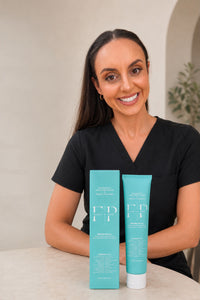
Oral Health Therapist (Bachelor of Oral Health Therapy, University of Newcastle, 2017), 9 years of clinical experience. Founder of Flossy & Pure.
References
Enax J, Fabritius H-O, Fabritius-Vilpoux K, Amaechi BT, Meyer F. Modes of action and clinical efficacy of particulate hydroxyapatite in preventive oral health care — state of the art. Open Dental Journal. 2019;13:274–287.
El Moshy S, Radwan IA, Matoug-Elwerfelli M, Abdou A, Abbass MM. A Novel Nano-Hydroxyapatite Agarose-Based Hydrogel for Biomimetic Remineralization of Demineralized Human Enamel: An in-vitro Study. Clinical, Cosmetic and Investigational Dentistry. 2024;16:453–465.