


Most family bathrooms hold the same lineup. A children's tube with a cartoon on it, an adult tube for whoever wants a stronger mint, and often a third because someone has a different preference again.
Nobody chose that. It accumulates. And the question underneath it, which I get asked constantly, is whether it needs to.
The answer depends on one thing: what the active ingredient is.
Why toothpaste is split by age
It is worth knowing rather than assuming it is packaging strategy.
Fluoride toothpaste comes in age-graded strengths, and Australian guidance sets different amounts and strengths for different ages while the adult teeth are still forming.
Small children cannot spit. Swallowing develops long before spitting does, and children's toothpaste is made to taste good, so a proportion of its users treat it as food. The guidance manages that: less paste, an age-appropriate strength, an adult supervising.
That is the main reason for the split. It is about one ingredient, fluoride, rather than children's teeth needing something different in general.
So when can a child move up?
For fluoride toothpaste, Australian guidance puts it at around age six, with supervision continuing until technique is reliable. Before that, a low-fluoride children's formula in an age-appropriate amount.
Check the current position with the Australian Dental Association or your child's dentist, who can advise on your child specifically.
The practical marker is not really a birthday. It is whether they can consistently spit out rather than swallow. Some seven-year-olds still cannot. Some five-year-olds manage it easily.
What changes if the active is not fluoride
This is the part most parents have not been told.
Hydroxyapatite is a mineral that occurs naturally in teeth and bones. It is not graded by strength for different ages, so there is no reason to buy a separate children's version.
Which means the reason for splitting the tube does not apply. There is no "adult strength" needing dilution for a smaller mouth. The same mild mint formula suits a seven-year-old and a seventy-year-old.
That is why a hydroxyapatite toothpaste can genuinely be one tube for the household. More in nano-hydroxyapatite vs fluoride.
What still varies, whatever is in the tube
Simplifying the toothpaste does not make everyone's needs identical.
- Amount. A smear under three, a pea from three to six, adult amounts after. Less paste for smaller mouths regardless of formula.
- Supervision. Brushing is a skill. Most children cannot do it adequately alone until around eight, and supervising is worth more than any product choice you will make.
- Flavour tolerance. Strong mint is a common and under-recognised reason children resist brushing. A milder flavour solves a surprising number of problems parents had read as defiance.
- Specific dental needs. Orthodontic appliances, dry mouth or a history of fillings may mean your dentist recommends something targeted, often prescription-strength fluoride. Then it is one tube for everyone else and a specific product for that person. Follow the dentist over the convenience.
What families report when they simplify
Two things come up, and neither is clinical.
The decision disappears. Nobody is checking which tube belongs to whom. It is a small daily choice most people did not notice making until it stopped.
Confidence goes up. This is the bigger one. Parents who have read a little about SLS or fluoride concentration often feel stuck between "good enough" and "actually right", buying a children's formula because it is marketed as safe without knowing what makes it different, or whether either tube is well formulated. One ingredient list to satisfy yourself about beats three.
Neither is a clinical outcome and I would not present them as one. They are why the change sticks, which matters, because the best routine is the one that actually happens twice a day.
The short version
Fluoride toothpaste is split by age so the amount and strength suit each age group. That is a legitimate reason and it applies to fluoride products.
If the active is hydroxyapatite the reason does not apply, and one formula across the household is a real simplification rather than a compromise in either direction. Adults are not getting a watered-down product and children are not getting an inappropriate one.
What does not change: the amount, the supervision, and following your dentist if anyone in the house has a specific clinical need.
Frequently asked questions
Can kids use adult toothpaste?
With fluoride toothpaste, Australian guidance puts the change at around age six, with supervision until spitting is reliable. Our fluoride-free hydroxyapatite toothpaste is not graded by age, so the same formula suits children and adults.
At what age can a child use family toothpaste?
Around six for fluoride formulas, though the practical marker is whether the child can consistently spit rather than swallow. Check with your child's dentist.
Is one toothpaste for the whole family a good idea?
It works when the toothpaste is made for every age, as ours is. It may not suit someone with a specific dental need, such as orthodontic appliances, where your dentist may recommend a targeted product.
What happens if a child swallows adult toothpaste?
Swallowing a little while learning to spit is common, which is why amounts are kept small and brushing is supervised. If a child has swallowed a large quantity of any toothpaste, contact the Poisons Information Centre on 13 11 26.
Do children need a special children's toothpaste?
With fluoride, follow the age-graded strength on the label until around six. A fluoride-free formula made for the whole family, like ours, is not graded by age, so one family tube works, with a smaller amount for little ones.
Flossy & Pure toothpaste is a cosmetic product and is not intended to diagnose, treat, cure or prevent any disease. For advice about your own teeth, speak with your dentist or Oral Health Therapist.
References
Australian Dental Association. Fluoride and oral health guidance.
Meyer F, Enax J, Amaechi BT, et al. Hydroxyapatite as remineralization agent for children's dental care. Frontiers in Dental Medicine. 2022;3:859560.
Walsh T, Worthington HV, Glenny AM, et al. Fluoride toothpastes of different concentrations for preventing dental caries. Cochrane Database of Systematic Reviews. 2019;3:CD007868.
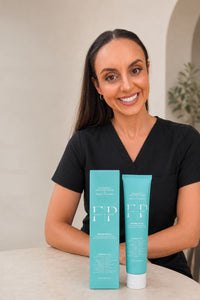
Oral Health Therapist (Bachelor of Oral Health Therapy, University of Newcastle, 2017), 9 years of clinical experience. Founder of Flossy & Pure.
Related reading
- Fluoride-free toothpaste for kids: a parent's guide
- Nano-hydroxyapatite vs fluoride
- Toothpaste ingredients to avoid
Not sure which formula suits you? Take the Enamel Check, a free 60-second quiz from an Oral Health Therapist.
We use 3% nano-hydroxyapatite. Our toothpaste is SLS-free and fluoride-free. We publish our percentage, which most of this category will not.