


Nano-Hydroxyapatite vs Fluoride: What the Research Actually Says
If you've been looking into fluoride-free toothpaste, you've probably come across nano-hydroxyapatite (nHAP) and you've probably also wondered whether it actually works as well as fluoride. As an Oral Health Therapist, this is one of the questions I get asked most often. Here's an honest, evidence-based answer.
What is nano-hydroxyapatite?
Hydroxyapatite is a naturally occurring mineral that makes up the majority of your tooth enamel. Nano-hydroxyapatite is simply this same mineral broken down into much smaller particles, which allows it to get into the microscopic gaps and cracks on the surface of your teeth more effectively than the standard form.
How does it compare to fluoride?
Fluoride has decades of research behind it, and for good reason it works. But nano-hydroxyapatite isn't a fringe alternative either. It has been used in oral care in Japan since the 1980s, and published research suggests it can support enamel remineralisation in a way that's comparable to fluoride, just through a different mechanism. Rather than altering the chemistry of your enamel the way fluoride does, nHAp works by physically filling in and rebuilding the tooth's surface with the same mineral it's already made of.
Why some people choose nHAp over fluoride
This isn't about fluoride being unsafe, it's about choice. Some people prefer to avoid it for personal or family reasons, some have sensitivities, and some simply want a more natural formulation without compromising on remineralisation. Nano-hydroxyapatite gives families that option.
The bottom line
Both ingredients aim to do the same job: protect and strengthen your enamel. The right choice comes down to your personal preferences and your dentist's advice for your specific needs.
Frequently Asked Questions
Is nano-hydroxyapatite as effective as fluoride?
Research suggests nano-hydroxyapatite can support enamel remineralisation in a manner comparable to fluoride, though the two work through different mechanisms. Nano-hydroxyapatite has been used in oral care in Japan since the 1980s.
Why do people choose fluoride-free toothpaste over fluoride?
Some people prefer to avoid fluoride due to personal sensitivity, family preference, or a desire for a more natural formulation. Nano-hydroxyapatite offers an alternative way to support enamel health without it.
Is nano-hydroxyapatite backed by scientific research?
Yes, published studies have examined nano-hydroxyapatite's role in enamel remineralisation, and it has decades of use in oral care products across Japan, Canada, and the EU.
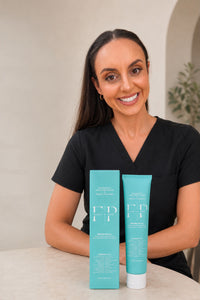
Oral Health Therapist (Bachelor of Oral Health Therapy, University of Newcastle, 2017), 9 years of clinical experience. Founder of Flossy & Pure.
References
Schlagenhauf U, et al. The Remineralizing and Desensitizing Potential of Hydroxyapatite in Dentistry: A Narrative Review of Recent Clinical Evidence. 2025.
Grocholewicz K, Matkowska-Cichocka G, Makowiecki P, et al. Effect of nano-hydroxyapatite and ozone on approximal initial caries: a randomized clinical trial. Scientific Reports. 2020;10:11192.