


I am going to disappoint you slightly: I am not going to rank them.
Not because I do not have opinions, but because a ranked list would require me to compare numbers that most of these brands refuse to publish. Any "best of" page you read that confidently ranks hydroxyapatite toothpastes is either guessing or repeating marketing copy.
What I can give you is the criteria a clinician actually uses, and an honest account of where the main options sit.
If you'd rather skip ahead: we have one. We use 3% nano-hydroxyapatite, with every ingredient listed. See the single tube ($21.99) or the Family 3-Pack ($59). Free shipping from $80.
Why nobody can rank these properly
The percentage is the one number worth checking. We use 3% nano-hydroxyapatite.
So concentration is the single most important number on the pack.
Most brands will not tell you theirs. Ask Boka and the answer is that the formula is proprietary. Ask Sangi, who make Apagard, the Japanese brand that started the category, and they will not disclose it either, though they will tell you the relative strengths between their own product lines.
You cannot honestly rank products on a specification that two of the three biggest names decline to publish. Anyone who does is inventing a hierarchy.
That is not an accusation of bad faith. Proprietary formulas are a legitimate commercial choice. It just means the comparison people want is not available, and pretending otherwise is worse than saying so.
What to compare instead
1. Is the concentration published?
The first filter, and it removes a lot of the field.
A brand that publishes the number has given you something to assess. A brand that will not has told you to trust them. Both are choices, and you are entitled to prefer the first.
2. Nano or non-nano?
They work differently and the label should say which.
Nano and non-nano are different particle sizes, and the label should say which one you are getting.
Some brands deliberately choose non-nano to avoid the broader regulatory conversation about nanomaterials. That is a defensible position. It should be stated, not left ambiguous. Full comparison in nano vs non-nano hydroxyapatite.
3. Is there anything working against it?
SLS is the big one. A foaming detergent some people prefer to avoid. Plenty of otherwise well-formulated hydroxyapatite toothpastes still include it.
Heavy abrasives, particularly in anything marketed as whitening. Adding mineral while scrubbing enamel off is not a coherent product.
4. Is it actually available here?
More of a practical filter than people expect. Australian retail stocking of this category is thin, and a lot of what is listed on marketplaces ships from overseas with the expiry, storage and consumer-guarantee problems that come with it. Covered properly in where to buy hydroxyapatite toothpaste in Australia.
5. Will the household actually use it?
The most underrated criterion. Strong mint is one of the most common reasons children refuse to brush, and a toothpaste nobody uses does nothing for anybody. Formulation quality is irrelevant if the tube stays in the cupboard.
Where the main options sit
Boka is the best known, American, widely available through marketplaces here. Nano-hydroxyapatite. Concentration not published. Their marketing is good and the product is well regarded.
Davids is another US brand, also fluoride-free, nano-hydroxyapatite, similarly widely available by import.
Apagard from Sangi is the Japanese original, the brand that started the category. Uses their own medical hydroxyapatite. Concentration not published, though relative strengths across their range are.
Australian options are still few, which is the actual reason this search exists.
Flossy & Pure is ours, so treat what follows accordingly. We use 3% nano-hydroxyapatite, and we publish that. SLS-free, fluoride-free, with L-arginine.
I am not going to tell you it beats the others, because on concentration alone some may well be higher and I have no way to know. What I will say is that you can check what is in ours, and that is the ground I would rather compete on.
Want to check ours against the criteria above? See the full ingredient list on the single tube ($21.99), or go straight to the Family 3-Pack if you already know it suits your household.
What I would actually do
- Shortlist the ones that publish a concentration. If that leaves you with very few options, that is informative in itself.
- Check nano or non-nano and decide which you want.
- Check for SLS in the first half of the panel.
- Buy one tube, not a bundle. Use it for a month. Texture and flavour are personal and you cannot judge them from a website.
- Then subscribe or bulk-buy, once you know.

Ready for step 5?
Already know it suits your household?
The Family 3-Pack is three 100g tubes of our toothpaste. We use 3% nano-hydroxyapatite. SLS-free, fluoride-free, with the percentage published. Enough for the whole bathroom, so nobody runs out mid-month.
$59 one-off, or $50.15 on Subscribe & Save (15% off every delivery).
Free shipping on orders from $80. Change your mind? Return it unopened within 30 days for a refund. Full terms.
Trying it first? Start with a single tube ($21.99).
And the honest caveat
The difference between two well-formulated hydroxyapatite toothpastes is smaller than the difference between using one properly and using one badly.
Not rinsing after brushing, brushing last thing at night, waiting after acidic food, cleaning between the teeth, eating on fewer separate occasions. Every one of those will matter more than which tube you pick.
Choose a product with a real active at a stated concentration and no SLS. Then stop optimising the purchase and start being consistent about the routine.
Not sure it's worth switching? Read is hydroxyapatite toothpaste worth it?
Frequently asked questions
What is the best hydroxyapatite toothpaste in Australia?
There is no honest ranking, because most brands in this category will not publish their hydroxyapatite concentration, which is the single most important specification. The useful approach is to shortlist products that do disclose it, check whether they are nano or non-nano, and check the panel for SLS.
Does Boka publish its hydroxyapatite percentage?
No. Boka describes its formula as proprietary and does not disclose the concentration publicly.
How much hydroxyapatite should toothpaste contain?
The percentage is the one number worth checking. We use 3% nano-hydroxyapatite. A product listing hydroxyapatite without stating how much cannot be assessed on this.
Is it better to buy hydroxyapatite toothpaste locally?
Not inherently, but buying locally avoids the shipping times, expiry-date and storage risks of grey-market imported stock, and keeps Australian Consumer Law protections intact.
What matters more than the brand?
Using it correctly. Not rinsing after brushing, brushing before bed, waiting after acidic food and cleaning between the teeth will each matter more than choosing between two well-formulated products.
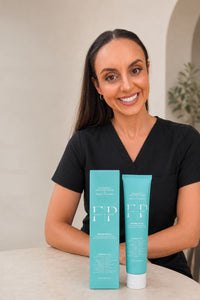
Oral Health Therapist (Bachelor of Oral Health Therapy, University of Newcastle, 2017), 9 years of clinical experience. Founder of Flossy & Pure.
Related reading
- Where to buy hydroxyapatite toothpaste in Australia
- Nano vs non-nano hydroxyapatite
- What makes a toothpaste truly natural?
Not sure which formula suits you? Take the Enamel Check, a free 60-second quiz from an Oral Health Therapist.
We use 3% nano-hydroxyapatite. Ours is SLS-free and fluoride-free. We publish our percentage, which most of this category will not.