


Yes. And the brands using non-nano usually have a reason for it that has nothing to do with how the paste performs in your mouth.
Both are hydroxyapatite, a mineral that occurs naturally in teeth and bones. The particles are just different sizes, and that changes how the paste behaves and feels.
What acid does to a tooth
Acid doesn't punch a hole straight through. It dissolves minerals out from underneath, leaving small pockets while the outer surface stays intact. Those pockets measure a few nanometres across.
Nano particles are about the same size as the crystals that occur naturally in teeth. That small size is what gives a nano-hydroxyapatite paste its smooth, polished feel.
Non-nano particles run roughly a thousand times larger, so the paste behaves differently on the tooth surface.
Both clean. Much of either rinses away with the water, which is one reason I suggest spitting rather than rinsing after brushing.
Why a brand picks the bigger particles
Regulators have taken an interest in very small particles across all sorts of products, from sunscreen to food. Some manufacturers would rather sidestep the whole conversation than answer questions about it, so they use larger particles.
As a business decision that holds up. Most of the published research on hydroxyapatite in toothpaste uses the nano form.
What regulators have said
The EU's Scientific Committee on Consumer Safety assessed hydroxyapatite in nano form for oral care and cleared it for that use.
The exposure regulators actually watch is inhalation, not swallowing. You don't breathe in a paste. That's why format matters more than the word on the box, and why powders and aerosols sit in a different category from toothpaste. I've gone through this properly in my plain-English guide to nano-hydroxyapatite toothpaste.
Two things I'd check before I checked particle size
Is there SLS in it?
Sodium lauryl sulfate is what makes toothpaste foam. Foam has never cleaned a tooth. Many people find SLS harsh on the inside of the mouth, and it sets off ulcers in people prone to them. A lot of hydroxyapatite toothpastes still contain it.
Will they tell you the percentage?
If a toothpaste leads with hydroxyapatite, it should tell you how much is in there. A trace amount listed to justify a claim on the front of the box is not the same product as one with a stated percentage. We use 3% nano-hydroxyapatite.
Here's what makes that hard to check. Two of the largest names in this category won't publish their concentration. The Japanese brand that pioneered hydroxyapatite toothpaste won't either. Ask, and the answer comes back as "proprietary".
You can't assess an ingredient when nobody will tell you how much of it is in the tube. A brand willing to state the number has told you something about how it operates before you've taken the cap off.
What to look for on the tube
- Nano or non-nano. If the pack says neither, you've still learned something.
- The percentage, published rather than proprietary.
- SLS, and whether it sits in the top half of the ingredient list.
- A named key ingredient.
People miss that last one. "No fluoride" tells you what was taken out, not what went in, so check what the paste is actually built around.
Frequently asked questions
What's the difference between nano and non-nano hydroxyapatite?
Particle size. Nano particles are around the same size as the crystals that occur naturally in teeth. Non-nano particles are around a thousand times larger, so the paste behaves and feels different.
Is non-nano hydroxyapatite as good as nano?
They are different. Most of the published research on hydroxyapatite toothpaste uses the nano form, and nano gives a smooth, polished feel. Either way, check the pack states the percentage.
Has nano-hydroxyapatite been assessed by regulators?
The EU's Scientific Committee on Consumer Safety assessed hydroxyapatite in nano form for oral care and cleared it for that use. The exposure regulators watch with small particles is inhalation rather than swallowing, which puts a paste in a different category from a powder or spray.
How do I tell which one I'm buying?
The pack or the product page should state it. When a brand publishes neither the particle size nor the percentage, you have no way to judge what you're getting.
Flossy & Pure toothpaste is a cosmetic product and is not intended to diagnose, treat, cure or prevent any disease. For advice about your own teeth, speak with your dentist or Oral Health Therapist.
References
Scientific Committee on Consumer Safety (SCCS). Opinion on hydroxyapatite (nano). European Commission.
Enax J, Epple M. Synthetic hydroxyapatite as a biomimetic oral care agent. Oral Health & Preventive Dentistry. 2018;16(1):7-19.
Limeback H, Enax J, Meyer F. Biomimetic hydroxyapatite and caries prevention: a systematic review and meta-analysis. Canadian Journal of Dental Hygiene. 2021;55(3):148-159.
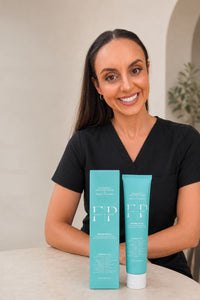
Oral Health Therapist (Bachelor of Oral Health Therapy, University of Newcastle, 2017), 9 years of clinical experience. Founder of Flossy & Pure.
Related reading
- Nano-hydroxyapatite toothpaste: common questions
- How nano-hydroxyapatite works
- The best hydroxyapatite toothpaste in Australia
Not sure which formula suits you? Take the Enamel Check, a free 60-second quiz from an Oral Health Therapist.
We use 3% nano-hydroxyapatite. Our toothpaste is SLS-free and fluoride-free. We publish our percentage, which most of this category will not.