


Mildly, yes. Not the way bleaching does, and not for every kind of discolouration.
The honest version of this answer depends on why your teeth are the colour they are, and most whitening marketing skips that part entirely.
Two completely different problems
Extrinsic staining sits on the surface. Tea, coffee, red wine, tobacco, curry. Pigment binds to the film of protein that coats your teeth. This is what polishing and most whitening toothpaste addresses, and it is removable.
Intrinsic colour comes from inside the tooth. The natural shade of your dentine, showing through the enamel. Genetics, ageing, certain antibiotics in childhood, trauma to a tooth. No toothpaste reaches this. Bleaching does, because peroxide penetrates the enamel and alters the pigment chemically.
Here is what almost nobody tells you: as enamel thins, teeth look yellower. Not because they are staining, but because thinner enamel is more translucent, and the yellow dentine underneath shows through more.
That distinction matters for what follows.
How hydroxyapatite affects colour
Three things, none of them bleaching.
It fills microscopic surface defects. Acid-damaged enamel has a rough, pitted surface at microscopic scale. Rough surfaces scatter light and look duller, and they also catch pigment more readily. Depositing mineral into those defects makes the surface smoother, which makes it reflect light more evenly and look brighter.
It makes the surface harder to stain. A smoother surface gives pigment less to hold on to. This is more about preventing future staining than removing what is there.
It addresses translucency. If your teeth look yellower because enamel has thinned, adding mineral back is the only thing on this page that touches the actual cause.
So the effect is real but indirect. It is optical rather than chemical. A brighter, smoother, less stain-prone surface, over weeks.
If you want a shade change, that is bleaching, and hydroxyapatite is not that.
What the research shows
A study published in Odontology found a hydroxyapatite toothpaste produced measurable tooth whitening over a matter of weeks, and mechanistic work supports the surface-smoothing route described above.
The measured effect is modest compared with peroxide. Anyone showing you a dramatic before and after from toothpaste alone is showing you either better lighting or a professional clean.
The trade nobody mentions
Most whitening toothpaste works by abrasion. It scrubs stain off, and the more aggressively it does that, the whiter the result looks in the short term.
Enamel does not grow back.
Highly abrasive pastes remove surface enamel along with the stain. Do that for years and the enamel thins, the dentine shows through more, and your teeth end up looking yellower than when you started. The product delivers the opposite of its promise on a long enough timeline.
If a product publishes an RDA figure, under 70 is gentle and over 150 is at the top of what is considered safe. Most brands do not publish it.
This is the actual argument for hydroxyapatite on whitening: it brightens by adding rather than removing, so it does not carry that trade.
For a brand-by-brand look, see the best hydroxyapatite toothpaste in Australia.
What actually works, in order
Honestly, ranked by effect:
- A professional clean. Nothing you buy comes close for extrinsic staining. Most people are astonished by the difference and it takes half an hour.
- Professional bleaching, if you want a genuine shade change. It works, and a dentist supervising means the concentration suits your teeth and the surrounding tissue is looked after.
- Reduce what is staining them. Not giving up coffee. Drinking it in a shorter window, rinsing with water afterwards, using a straw for cold drinks that stain.
- A hydroxyapatite toothpaste, for a gradual brightening and a smoother surface that resists staining. Slower and subtler than the above.
- Not scrubbing your enamel away with an abrasive whitening paste.
What I would avoid
Charcoal toothpaste. Highly abrasive, no good evidence of whitening beyond mechanical scrubbing, and it can lodge around the edges of teeth and fillings. Several dental associations have advised against it.
DIY bicarb and lemon juice. Acid plus abrasive, which is the exact combination that thins enamel fastest.
Anything promising a shade change from a tube. Toothpaste that genuinely bleached would need peroxide at a concentration that requires supervision.
Realistic expectations
Over six to eight weeks of twice-daily use, expect your teeth to look a bit brighter and cleaner and to pick up new stain more slowly. Expect it to be subtle enough that you notice it before anyone else does.
If you want a visible shade change on a deadline, book a clean and talk to your dentist about bleaching. A toothpaste is a maintenance tool, and the honest framing is that it keeps teeth looking good rather than transforming them.
Frequently asked questions
Does hydroxyapatite toothpaste whiten teeth?
Mildly, and by a different route to bleaching. It fills microscopic surface defects so enamel reflects light more evenly, and makes the surface smoother so pigment binds less easily. The effect is gradual and modest, not a shade change.
Is hydroxyapatite better than whitening toothpaste?
It depends what you are optimising for. Most whitening toothpaste works by abrasion, which removes stain along with a little enamel each time. Hydroxyapatite brightens by adding mineral rather than removing surface, so it does not carry that long-term trade.
How long does hydroxyapatite take to whiten teeth?
Studies measuring whitening effects typically run over several weeks. Expect gradual change over six to eight weeks of twice-daily use rather than anything visible in days.
Why do my teeth look yellow even though I brush?
Often because enamel has thinned. Thinner enamel is more translucent, so the naturally yellow dentine beneath shows through more. That is not staining, and no amount of scrubbing will fix it. Abrasive whitening toothpaste makes it worse.
Is charcoal toothpaste safe for whitening?
Charcoal toothpaste is highly abrasive with little good evidence of whitening beyond mechanical scrubbing, and it can lodge around the edges of teeth and fillings. Several dental associations have advised against routine use.
References
Niwa M, Sato T, Li W, et al. Polishing and whitening properties of toothpaste containing hydroxyapatite. Journal of Materials Science: Materials in Medicine. 2001;12(3):277-281.
Steinert S, Zwanzig K, Doenges H, et al. Daily application of a toothpaste with biomimetic hydroxyapatite and its subjective impact on dentin hypersensitivity, tooth smoothness, tooth whitening, gum bleeding, and feeling of freshness. Biomimetics. 2020;5(2):17.
Enax J, Epple M. Synthetic hydroxyapatite as a biomimetic oral care agent. Oral Health & Preventive Dentistry. 2018;16(1):7-19.
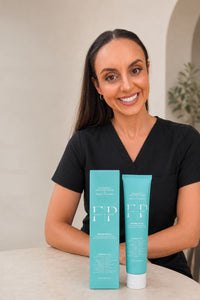
Oral Health Therapist (Bachelor of Oral Health Therapy, University of Newcastle, 2017), 9 years of clinical experience. Founder of Flossy & Pure.
Related reading
Not sure which formula suits you? Take the Enamel Check, a free 60-second quiz from an Oral Health Therapist.
We use 3% nano-hydroxyapatite. Our toothpaste is SLS-free and fluoride-free. We publish our percentage, which most of this category will not.