


Foam has never cleaned a tooth.
It is worth sitting with that, because almost everyone assumes the opposite. The lather is doing nothing. It is there because we expect it, and we expect it because we have been shown it in advertising for seventy years.
If you get mouth ulcers, this is the single change most likely to help you.
What SLS is doing in there
Sodium lauryl sulfate is a surfactant. The same class of chemistry as washing-up liquid and shampoo, at a lower concentration.
Its job is to lower surface tension so the paste spreads, and to create foam. Neither removes plaque. Plaque is a biofilm stuck to the tooth, and it comes off by mechanical disruption: bristles, and interdental cleaning. The active ingredients then do their work on the cleaned surface.
Foam contributes nothing to either step. It just makes the two minutes feel like something is happening.
The ulcer connection
This is the part with the clearest evidence.
SLS is a known irritant to the mouth lining. It strips the mucin layer that protects the soft tissue inside your cheeks, lips and under the tongue. In people prone to recurrent aphthous ulcers, the ones that arrive in the same few spots and take a fortnight to go, removing SLS is associated with getting fewer of them.
The classic study here is Herlofson and Barkvoll in 1994, and several subsequent studies have found similar results. It is not universal, but the association is consistent enough that switching is the first thing I suggest to any patient who tells me they get ulcers regularly.
If you get mouth ulcers, try an SLS-free toothpaste for six weeks. It is one of the few interventions in oral health that costs nothing extra, has no downside, and has a reasonable chance of a noticeable result.
The other things SLS does
It ruins the taste of food. SLS temporarily disrupts the phospholipids on your taste receptors that normally suppress bitterness. That is why orange juice tastes appalling after brushing. Not the toothpaste flavour clashing, an actual chemical effect on your tongue.
It dries the mouth. Surfactants can contribute to dryness, and saliva is what buffers acid and carries mineral back to your enamel. Anything reducing saliva is working against the rest of your oral care.
It disturbs the oral microbiome. Detergents disrupt lipid membranes and do not distinguish between a bacterial membrane and your own tissue. More on this in the oral microbiome.
It makes brushing uncomfortable for children. Smaller mouths, more delicate tissue. I have had parents describe a child as impossible about brushing when the actual problem was a stinging detergent. Changing the toothpaste solved a behavioural problem that was not behavioural.
Is SLS dangerous?
No, and I would rather say that plainly than let this page become another "toxic ingredient" article.
SLS is not carcinogenic. That claim circulated widely online and has been examined and rejected by cancer research organisations. At toothpaste concentrations it is not going to harm you.
The argument against it is different and simpler: it does nothing useful and it irritates a meaningful number of people. You do not need a toxicity claim to justify leaving out an ingredient with no benefit.
That distinction matters. A brand that tells you SLS causes cancer is a brand you should not trust on anything else either.
What to expect when you switch
Much less foam. This is the adjustment. The first week feels like the toothpaste is not working, because you have decades of association between lather and clean. Your teeth are getting exactly as clean.
Food tastes normal afterwards. Most people notice this within a few days and are surprised by it.
Fewer ulcers, if you got them. Six weeks is a fair trial.
Nothing else changes. Cleaning comes from the brushing.
Reading the panel
SLS appears as:
- Sodium lauryl sulfate
- Sodium laureth sulfate
- Sodium dodecyl sulfate
Gentler surfactants that some brands use instead:
- Sodium cocoyl glutamate
- Cocamidopropyl betaine, though this one is itself a contact allergen for some people
- Decyl glucoside
Position matters. Ingredients are listed heaviest first, so an SLS appearing in the first half of the panel is present in a real amount.
Worth knowing: "SLS-free" is not a regulated claim any more than "natural" is. Check the panel rather than the front of the pack, and watch for products that swap SLS for a chemically similar surfactant while advertising the removal.
The one-line version
Foam is theatre. If you get mouth ulcers, drop the SLS and give it six weeks. If you do not, drop it anyway, because you are giving up nothing.
Frequently asked questions
Is SLS in toothpaste bad for you?
SLS is not dangerous at toothpaste concentrations and the claim that it causes cancer has been examined and rejected. It is a known irritant to the mouth lining, is associated with recurrent mouth ulcers in susceptible people, and provides no cleaning benefit beyond producing foam.
Does SLS-free toothpaste clean as well?
Yes. Plaque removal comes from mechanical disruption by the brush and from the active ingredients, not from foam. The lather contributes nothing to cleaning.
Will SLS-free toothpaste help my mouth ulcers?
It may. Studies have found people prone to recurrent aphthous ulcers experience fewer of them on SLS-free toothpaste. It is worth a six-week trial, since there is no downside and it is one of the few free interventions in oral health.
Why does orange juice taste bad after brushing?
SLS temporarily disrupts the compounds on your taste receptors that normally suppress bitterness, so acidic and sweet foods taste wrong for a while afterwards. On SLS-free toothpaste most people find this stops.
How do I know if my toothpaste has SLS?
Check the ingredient panel for sodium lauryl sulfate, sodium laureth sulfate or sodium dodecyl sulfate. Ingredients are listed heaviest first, so one appearing in the first half of the list is present in a meaningful amount. "SLS-free" on the front is not a regulated claim.
References
Herlofson BB, Barkvoll P. Sodium lauryl sulfate and recurrent aphthous ulcers. A preliminary study. Acta Odontologica Scandinavica. 1994;52(5):257-259.
Chahine L, Sempson N, Wagoner C. The effect of sodium lauryl sulfate on recurrent aphthous ulcers: a clinical study. Compendium of Continuing Education in Dentistry. 1997;18(12):1238-1240.
Barkvoll P, Rolla G. Possible effects of sodium lauryl sulphate on the oral mucosa. Journal of Dental Research. 1989;68:991.
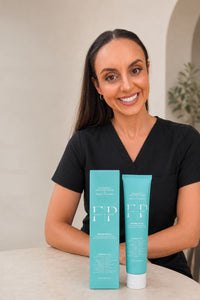
Oral Health Therapist (Bachelor of Oral Health Therapy, University of Newcastle, 2017), 9 years of clinical experience. Founder of Flossy & Pure.
Related reading
Not sure which formula suits you? Take the Enamel Check, a free 60-second quiz from an Oral Health Therapist.
We use 3% nano-hydroxyapatite. Our toothpaste is SLS-free and fluoride-free. We publish our percentage, which most of this category will not.